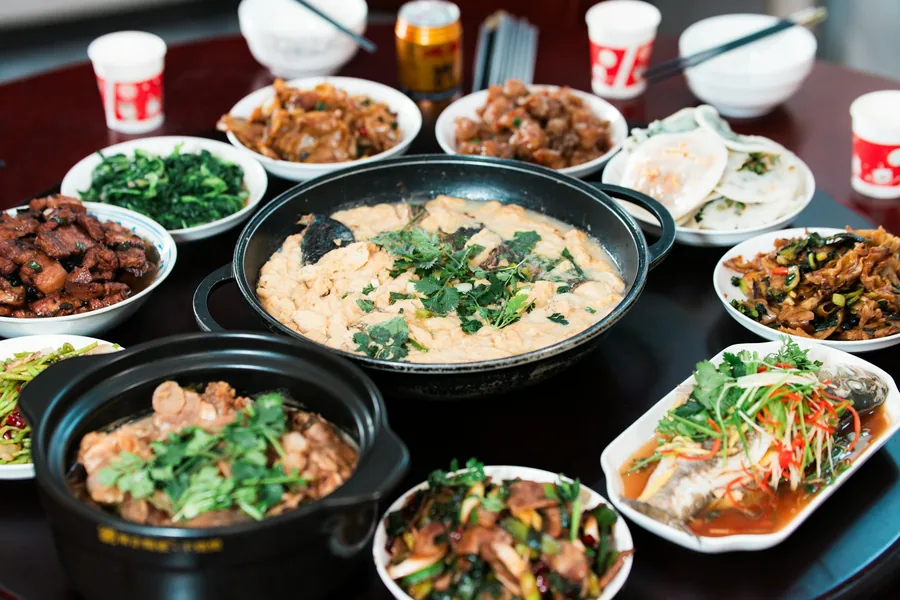
Open a Chinese takeout menu for the first time and the reaction is usually the same: this is too much. Sections running to twenty dishes each, numbers into the hundreds, and no obvious place to start. It is not as complicated as it looks, because most of it is the same handful of ideas repeated.
The short answer
A Chinese menu is a grid, not a list. A small set of proteins is crossed with a small set of sauces and formats. Learn one row and one column and you can read the whole thing.
What the repetition actually looks like
This menu carries 284 listings across 18 sections. That sounds like 284 recipes. It is not. Take the six sections that are built around a format rather than a protein:
| Section | Listings | What it is |
|---|---|---|
| Fried Rice | 14 | The same proteins, fried with rice |
| Lo Mein | 13 | The same proteins, with soft noodles |
| Chop Suey | 10 | The same proteins, in a light sauce over rice |
| Chow Mein | 10 | The same proteins, with crisp noodles |
| Chow Mei Fun | 7 | The same proteins, with rice noodles |
| Egg Foo Young | 6 | The same proteins, in an egg patty |
That is sixty listings. Underneath them sit six proteins — chicken, roast pork, beef, shrimp, vegetable and house special — and six formats. Chop suey and chow mein carry exactly the same five proteins as each other. Once you know that, sixty listings collapse into one decision about protein and one about format.
The same trick runs through the entrées
The protein sections work the same way in the other direction. Instead of one protein across many formats, it is one preparation across many proteins.
- With broccoli appears in all five of the beef, pork, seafood, chicken and vegetable sections.
- Garlic sauce appears in all five as well.
- Szechuan style, Hunan style and moo shu each appear in four.
- Curry sauce appears in four; snow peas in three.
- Black bean sauce and cashew nuts each appear in two.
So the beef section is not nineteen unrelated dishes. It is a handful of preparations you will meet again under chicken, pork and seafood, with beef in them.
Why kitchens build menus this way
Two reasons, one practical and one cultural.
The practical one is that it costs a kitchen almost nothing. The sauces, the prepped proteins and the cut vegetables are all made in bulk and assembled to order, so adding beef with garlic sauce to a menu that already has chicken with garlic sauce adds a line of print and no new work.
The cultural one is that a long menu does a job. Chinese-American restaurants have historically served very different customers from the same kitchen, and the length is what lets them do it. The Harvard Crimson made this case well in a column arguing that long Chinese menus are long for a reason, and that pressure to trim them misreads what they are for.
The count is inflated too
Part of the intimidation is bookkeeping. Most dishes here are listed twice, once small and once large, so the 284 listings are closer to 200 distinct dishes. Add the dinner specials, which are versions of dishes already on the menu bundled with rice and a starter, and the number of genuinely separate things drops again.
None of which makes the menu shorter to look at. It does mean the thing you are scanning is far more repetitive, and therefore far more learnable, than it first appears.
When a long menu is a bad sign
It is worth being fair to the criticism. A long menu is efficient when the dishes share components and inefficient when they do not. A kitchen listing stir fries alongside sushi, pizza and curries is promising range it cannot prep for, and that is a different situation entirely.
The test is whether the length comes from repetition or from sprawl. On a menu like this one, almost every listing is a variation on something else on the same page — which is exactly the case where a long list costs the kitchen nothing and gives you more to choose from.
How to navigate one quickly
The mistake almost everyone makes is reading down. You start at appetizers, work through soups, and lose momentum somewhere in the middle of chicken. Read across instead.
- Pick the format first. Do you want rice, noodles, or a dish with rice alongside? That removes most of the menu immediately.
- Pick the protein. That takes you to one section.
- Pick the preparation. Sauce or vegetable — this is the only real decision left.
- Check the markings. Spicy notes and section notes are where the surprises live.
Done in that order it takes under a minute. The guide to choosing between beef, chicken, pork and seafood covers step two, and Chinese sauces explained covers step three.
What the sections actually are
If you want the map rather than the method, this menu divides into four kinds of section: the starters — appetizers, soups; the format sections — fried rice, lo mein, chow mein, chop suey, mei fun, egg foo young, sweet and sour; the protein sections — beef, pork, seafood, chicken, vegetables; and the assembled sections — house specials, dinner specials, Special Chinese American Dishes, and drinks and sides.
The menu glossary covers what the words in each of them mean, and what comes with each section covers which of them include a starch.
One useful consequence
Because the grid is real, you can order confidently off the edge of your experience. If you like one cell, the cells next to it are a safe bet: same sauce, different protein, or same protein, different format. That is a far better way to explore a long menu than picking at random.
Frequently asked questions
Why do Chinese restaurants have so many dishes?
Because most of the menu is a grid rather than a list. A modest set of proteins is combined with a modest set of sauces and formats, so a few dozen components produce a few hundred listings.
Are all those dishes really different?
Less than the count suggests. Many are the same preparation with a different protein, or the same dish in a small and a large size listed separately.
How do I find something on a very long menu?
Pick your sauce or preparation first, then find it in the section for the protein you want. Reading down a section is much slower than reading across the menu for the preparation you already like.
Does a long menu mean the food is worse?
Not by itself. Long menus are efficient when the dishes share components, because the kitchen is assembling from the same prepped ingredients rather than cooking hundreds of unrelated recipes.
The bottom line
Two hundred and eighty-four listings, roughly two hundred distinct dishes, built from about a dozen preparations and half a dozen proteins. Read across rather than down and the longest menu in the neighbourhood becomes the easiest one to order from.
Eighteen sections, and far more pattern than the count suggests.
Browse the full menu